
How to Choose a Kitchen Faucet: Types, Features and What to Measure First
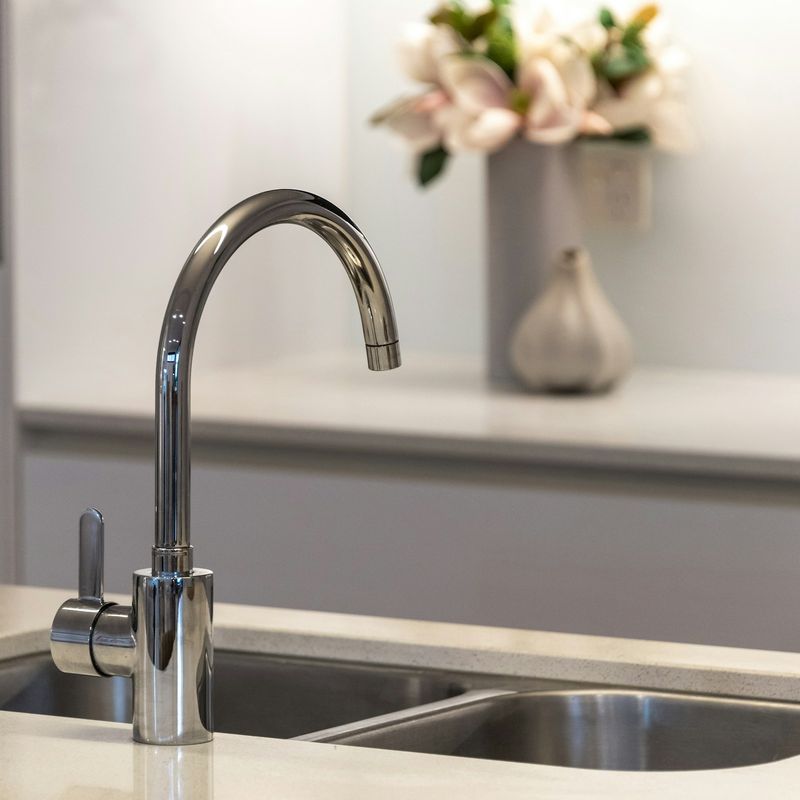
Short answer: start with your sink, not the faucet. Count the mounting holes, check the space behind the sink for the handle and measure how deep the basin is. Then pick a style: a single-handle pull-down is the easiest to live with for most kitchens, a two-handle faucet gives slightly finer temperature control, and a hands-free faucet suits messy cooks. Look for ceramic disc valves, a durable finish and a flow rate that meets your local rules.
Measure the sink before you shop
- Mounting holes: most sinks come pre-drilled for a faucet plus extras like a side spray or soap dispenser. Match what you have, or use a base plate to cover extra holes. Don’t buy a faucet that needs more holes than your sink has; drilling new holes in an existing sink or countertop isn’t a good idea.
- Clearance behind the sink: for a single-handle faucet, check the distance to the backsplash or window ledge so the handle doesn’t hit it when it rotates.
- Reach: the spout should swing far enough to cover the whole sink, especially a wide or double-bowl sink, and stay in proportion to it.
From Consumer Reports, “Faucet Buying Guide”, sections “Match the Faucet With the Number of Mounting Holes”, “Spout Styles and Shapes” and “Single-Handle Faucets”, read November 1, 2026.
Kitchen faucet types compared
| Type | Good | Watch out for |
|---|---|---|
| Single-handle | Easier to use and install, takes less space | Slightly less precise temperature control |
| Two-handle | Slightly more precise temperature control | Harder to install; needs both hands to adjust; sprayer usually separate |
| Pull-out / pull-down | Spray head on a hose for rinsing produce and the sink; a counterweight retracts it | Hose must reach every corner; may be overkill for a small sink |
| Hands-free (sensor) | No touching with full or dirty hands | Sensors placed low or at the back are hard to find; prefer one with a manual override |
| Pot filler | Fills big pots right at the stove | Needs a water line behind the stove; only worth it if you cook a lot |
| Bar / prep faucet | Frees up the main sink; can connect to an instant hot or filtered cold water dispenser | Needs a second sink and the space for it |
From Consumer Reports, “Faucet Buying Guide”, section “Water Works: Shopping Faucet Types”, read November 1, 2026.
Spout shape
Straight spouts are compact, but you may need to swing the faucet aside to fit a big pot under it. Gooseneck (high-arc) spouts give more clearance but can splash in a shallow sink.
From Consumer Reports, “Faucet Buying Guide”, section “Spout Styles and Shapes”, read November 1, 2026.
Features worth paying attention to
- Ceramic disc valves: older compression valves used washers that wore out and dripped; ceramic discs have no washers to erode and are now mainstream.
- Finish: PVD finishes resisted Consumer Reports’ scratching attempts but can be slightly stained by corrosives such as drain cleaner. Chrome is durable but a heavy-duty scouring pad can scratch it; brushed stainless hides scratches and stains better than chrome.
- Spray/stream button: easy to reach on the spray head, and it should stay in the mode you chose until you change it.
- Magnetic docking: on pull-out and pull-down faucets, a magnet locks the spray head back in place.
- Temperature memory: some single-handle faucets hold your last temperature setting after you turn them off.
From Consumer Reports, “Faucet Buying Guide”, sections “Good Hydrations: Faucet Features” and “How Not To Be A Drip”, read November 1, 2026.
Flow rate: what the gpm number means
Federal efficiency standards cap kitchen faucets at 2.2 gallons per minute (gpm) at 60 psi of water pressure. Many models are made with maximum flow rates of 1.5 to 1.8 gpm, for more efficiency or to meet local rules, and some states require kitchen faucets to flow below the federal limit; in some cases a faucet may have a temporary “boost” mode for filling pots that switches back to the normal flow once it is turned off. There is no WaterSense label for kitchen faucets; the EPA points to models certified to the national plumbing fittings standard (ASME A112.18.1/CSA B125.1).
From U.S. EPA WaterSense, “Kitchen Faucets” technical fact sheet (EPA-832-F-23-016, July 2023), read November 1, 2026.
Installation
Replacing the faucet and sink together is easier, because the faucet can go into the sink or countertop before the sink is set in place. Fittings you can tighten with a screwdriver and long supply hoses (so connections sit lower in the cabinet, where tools fit) make the job simpler. If a faucet under warranty leaks, the maker typically sends only the replacement part, and installing it is up to you.
From Consumer Reports, “Faucet Buying Guide”, section “Installation and Repair”, read November 1, 2026.
Our own tips (not from those sources): take a photo of the space under your sink, including the shut-off valves and supply lines, before you shop; check the faucet’s listed spout height against your tallest pot; and turn off both shut-off valves and test them before removing the old faucet.
Before you buy
- Number of holes in your sink or countertop
- Space behind the sink for the handle to rotate
- Spout reach and height vs your sink and pots
- Single- or two-handle, pull-down or hands-free
- Ceramic disc valve
- Finish you can live with (and clean)
- Flow rate allowed where you live
- Warranty terms and who installs replacement parts
Shop kitchen faucets on Amazon
Check the number of mounting holes, spout height and reach, valve type and flow rate on each listing.
Keep reading
See all kitchen faucets, or read our dishwasher buying guide and should you rinse dishes before the dishwasher?
Disclosure: As an Amazon Associate we earn from qualifying purchases. We also earn commissions from eBay and other retailers' affiliate links. Shop links on this page are affiliate links and are marked sponsored.