
What Size Range Hood Do You Need? CFM Chart for 30″ and 36″ Ranges
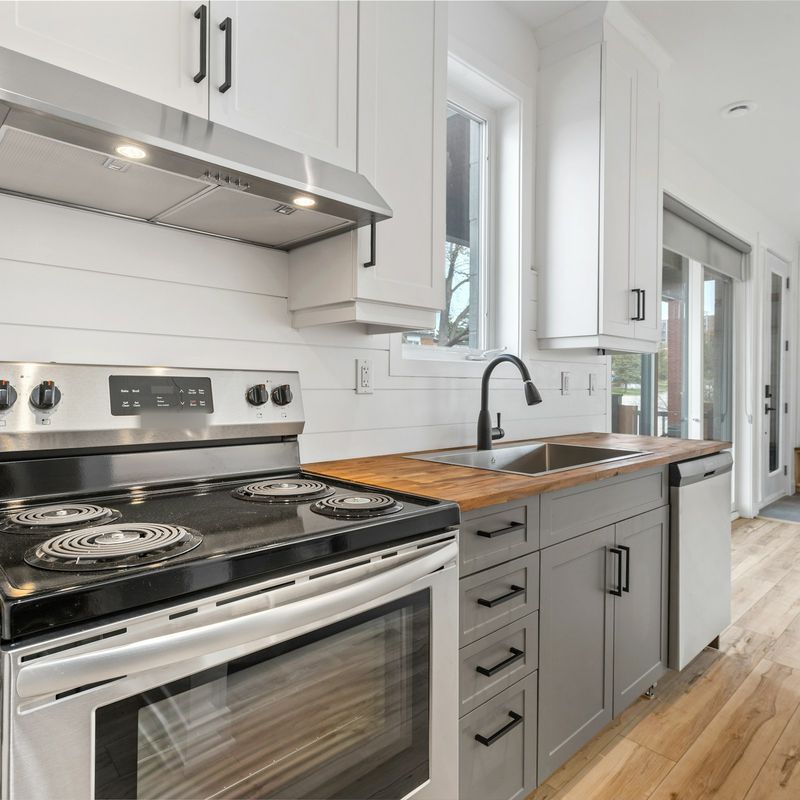
Short answer: for a range against a wall, the Home Ventilating Institute (HVI) recommends 100 CFM per linear foot of range, so about 250 CFM for a 30-inch range and 300 CFM for a 36-inch one. Over an island, multiply by 1.5 (150 CFM per foot). Pick a hood that vents outside rather than recirculating, look for an HVI-certified airflow rating, and if you’re looking at a very powerful hood, check your local code on makeup air before you buy.
Range hood CFM chart
| Range width | Against a wall: HVI-recommended | Against a wall: minimum | Over an island (× 1.5) |
|---|---|---|---|
| 30 in (2.5 ft) | 250 CFM | 100 CFM | 375 CFM |
| 36 in (3 ft) | 300 CFM | 120 CFM | 450 CFM |
| 48 in (4 ft) | 400 CFM | 160 CFM | 600 CFM |
The per-foot rates behind the chart: against a wall, 100 CFM recommended and 40 CFM minimum per linear foot; in an island, 150 CFM recommended and 50 CFM minimum. The island column is the wall figure × 1.5, as HVI suggests.
From Home Ventilating Institute, “How Much Ventilation Do I Need?”, read October 29, 2026.
What CFM means
CFM is cubic feet per minute: how much air the hood’s fan can move. More CFM pulls out more smoke, steam, grease and cooking odors, but it also means more noise and more indoor air pushed outside. Hoods with several speeds let you run a quiet low setting for light cooking and turn it up when you sear or stir-fry.
How to size your range hood, step by step
- Measure your range or cooktop width in feet (30 inches = 2.5 feet).
- Multiply by 100 if the range is against a wall, or by 150 if it’s in an island. That’s your target CFM.
- Check the minimum: 40 CFM per foot against a wall, 50 per foot over an island. Don’t go below it.
- Got a high-output or “professional-style” gas cooktop? HVI says to follow the cooktop maker’s advice for these instead of the per-foot rule. A rule of thumb you’ll often see is about 1 CFM for every 100 BTU of total burner output; treat it as a rough check, and use the cooktop manual if it gives a figure.
- Look for an HVI-certified rating. HVI notes that inflated performance ratings are common on hoods that aren’t certified. The certified airflow rating appears on the product or its HVI label and in HVI’s certified products directory.
Rates and certification note from Home Ventilating Institute, “How Much Ventilation Do I Need?”, read October 29, 2026. The BTU rule of thumb is a common industry guideline, not an HVI figure.
Ducted vs recirculating vs downdraft
- Ducted (vented outside): the best choice for air quality. HVI says to always use hoods, fans or downdraft exhausters that vent directly outside.
- Recirculating (ductless): filters the air and blows it back into the kitchen. HVI says non-ducted, recirculating hoods provide no actual ventilation. They can still catch some grease, but they don’t remove heat, moisture or combustion gases.
- Downdraft: pulls air sideways or down at the cooktop. HVI says these need more air volume and speed to capture fumes and can’t match a hood that captures the rising column of air above the stove; check the range maker’s recommendations before choosing one.
From Home Ventilating Institute, “How Much Ventilation Do I Need?”, read October 29, 2026.
Makeup air and bigger hoods
A strong hood pushes a lot of indoor air outside, and that air has to be replaced. Many US building codes require a makeup air supply once a kitchen hood exceeds a set airflow, commonly 400 CFM in codes based on the International Residential Code. Rules vary by city and state, so check with your local building department or installer before buying a hood above about 400 CFM. Bigger isn’t automatically better: a hood sized to your range, ducted outside, usually beats an oversized one.
Other things to check before you buy
- Width: at least as wide as your cooktop, so it covers the back and front burners. A little wider helps catch more.
- Mounting style: under-cabinet, wall chimney, island or insert, matching where your range sits.
- Duct size and route: the hood’s duct outlet must match a duct you can actually run outside; long runs and many bends reduce real airflow.
- Noise: listings often give a sone rating; lower is quieter. Compare the sones at the speed you’ll use most, not just the lowest setting.
- Filters: washable metal filters are easier to keep up with; check whether they go in the dishwasher.
- Lighting and controls: bright, even light on the cooktop and controls you can reach easily.
Still picking the range itself? Read our gas vs electric vs induction guide.
Range hood checklist
- Range width measured
- Target CFM: 100 per foot (wall) or 150 per foot (island)
- Maker’s advice checked for a professional-style gas cooktop
- HVI-certified airflow rating
- Ducted to the outside if at all possible
- Hood at least as wide as the cooktop
- Duct size and route confirmed
- Local makeup air rules checked for hoods above about 400 CFM
- Noise (sones) and filter type compared
Shop ranges on Amazon
Check each listing’s width, fuel type and dimensions, and compare hoods by HVI-certified CFM, duct size and noise.
Keep reading
See all ranges and air purifiers, or read our air purifier size guide.
Disclosure: As an Amazon Associate we earn from qualifying purchases. We also earn commissions from eBay and other retailers' affiliate links. Shop links on this page are affiliate links and are marked sponsored.